
On this page
The short version: a shelf price is built in layers, and every layer takes a cut before you do. Your cost becomes your wholesale price, a distributor adds ~15–25%, the retailer takes their margin (~25–35% in conventional grocery, ~35–50% in natural), and slotting plus trade spend come off the top. A “50% gross margin” is where you start — after everyone is paid, your real contribution margin often lands around 10–20% of the shelf price. This guide walks every layer, with the real ranges, so you can price backwards from the shelf instead of guessing forwards from cost.
Ask ten founders what margin their product runs and you’ll get ten different numbers — because they’re all answering a different question. “Margin” in CPG isn’t one number; it’s a stack of them, and the stack is where good brands quietly lose money. You can nail a beautiful 50% gross margin in the spreadsheet and still make almost nothing per unit once the channel takes its layers.
So let’s build the price the way it’s actually built — from your cost, up through every hand it passes, to the sticker on the shelf. Once you can see the whole waterfall, pricing stops being a mystery and starts being arithmetic.
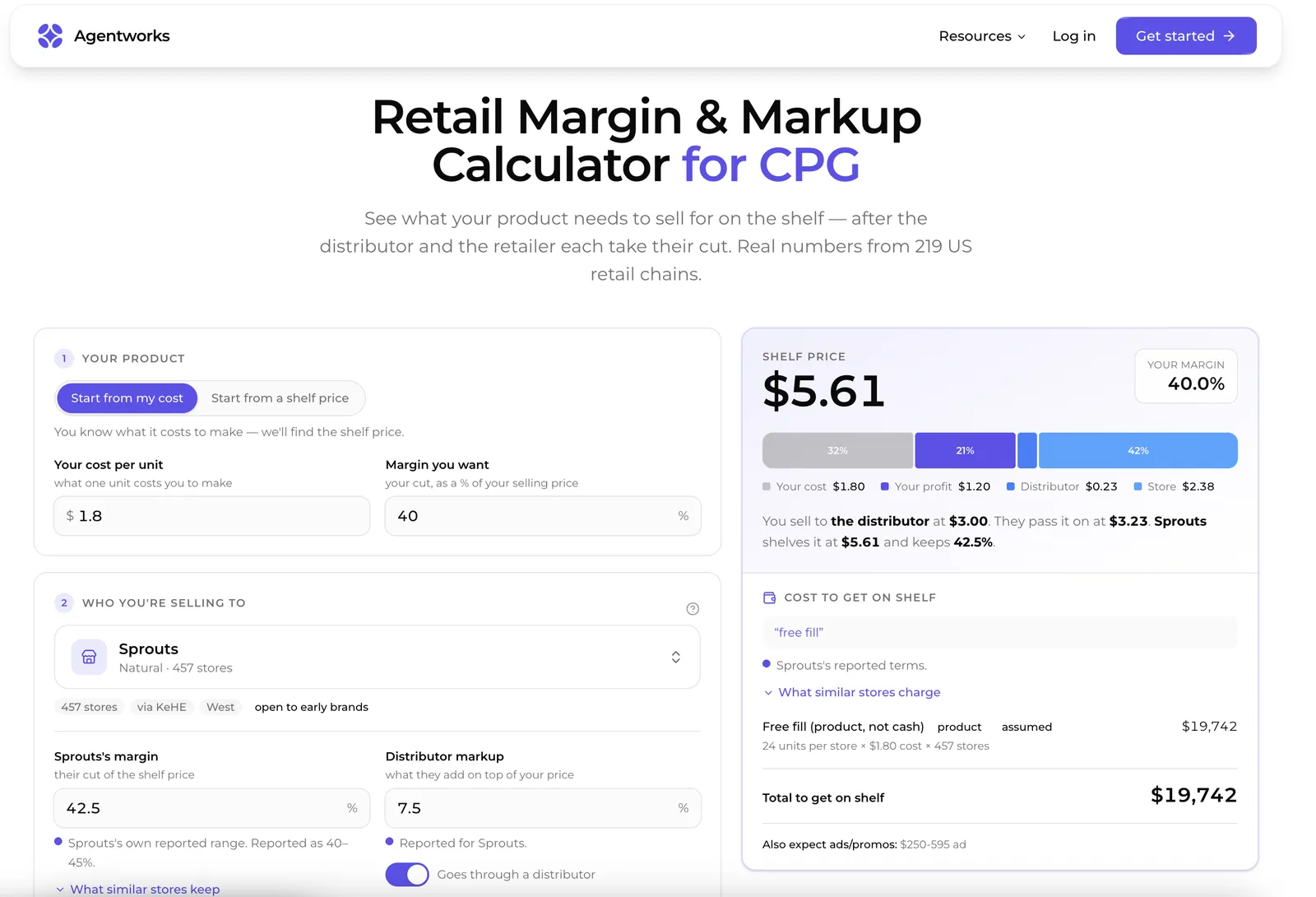
The cost-to-shelf waterfall
Here’s the chain a product travels, and who takes a cut at each step:
- Your COGS — your landed cost to make the unit, freight included. This is the floor.
- Your wholesale price — COGS plus your own margin. This is what you sell for.
- The distributor’s markup — ~15–25% on top of your wholesale, if you go through one.
- The retailer’s margin — their cut of the shelf price, which sets the final sticker.
- Slotting & trade spend — the fees and promotions that come off your side, not theirs.
A worked example makes it concrete. Say your landed cost is $2.00, you want a 40% margin, you sell through a distributor taking 15%, and you’re in a channel where the retailer wants 40%:
The number that surprises people isn’t the $6.39 shelf price — it’s that a product costing $2 has to sell for more than three times that just to leave everyone whole. That’s not greed on anyone’s part; it’s a queue. Everybody in the chain eats before you do. Price it too low and you either eat the difference yourself or blow past what shoppers will actually pay.
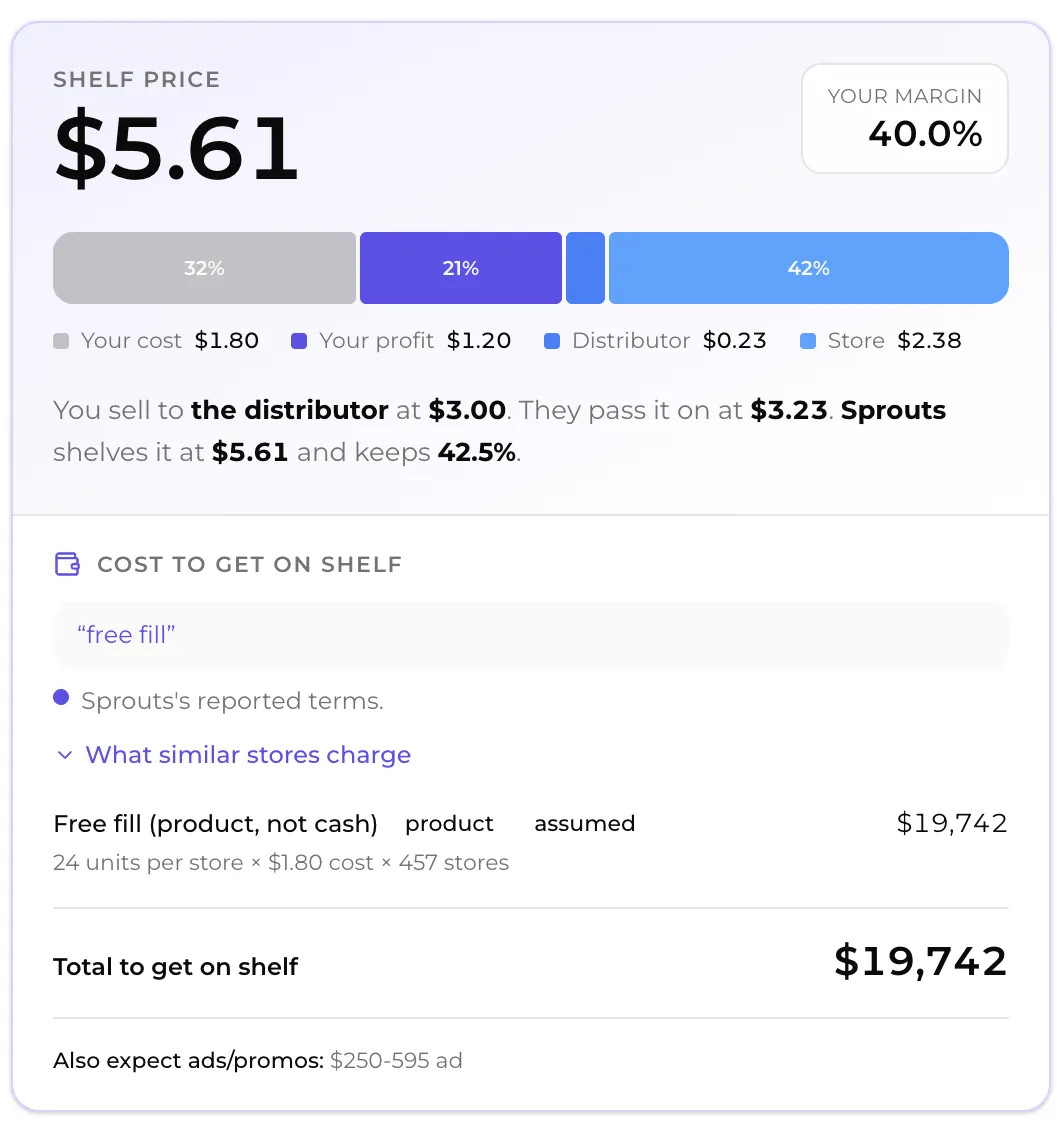
Want to run your own numbers? The free retail margin & markup calculator builds this waterfall for your cost, your channel, and 219 real US chains.
Why veterans say “price at 4–5× your cost”
Somewhere in your first year, a grizzled operator at a trade show will tell you to price your product at four or five times your cost, and it’ll sound insane. The bare waterfall above only came to about 3.2× — so where do the other layers come from?
They come from everything the clean example left out: trade spend (the promos you fund to stay on shelf, ~15–20% of sales), slotting amortized over your first year, freight surprises, chargebacks, and a manufacturer margin fat enough to actually reinvest. Stack those on and 3× quietly becomes 4–5×. So the veteran isn’t being conservative — they’ve just paid the tuition. If your shelf price is 2× your cost, that’s not a lean operation; that’s a future cash-flow apology with a nice label.
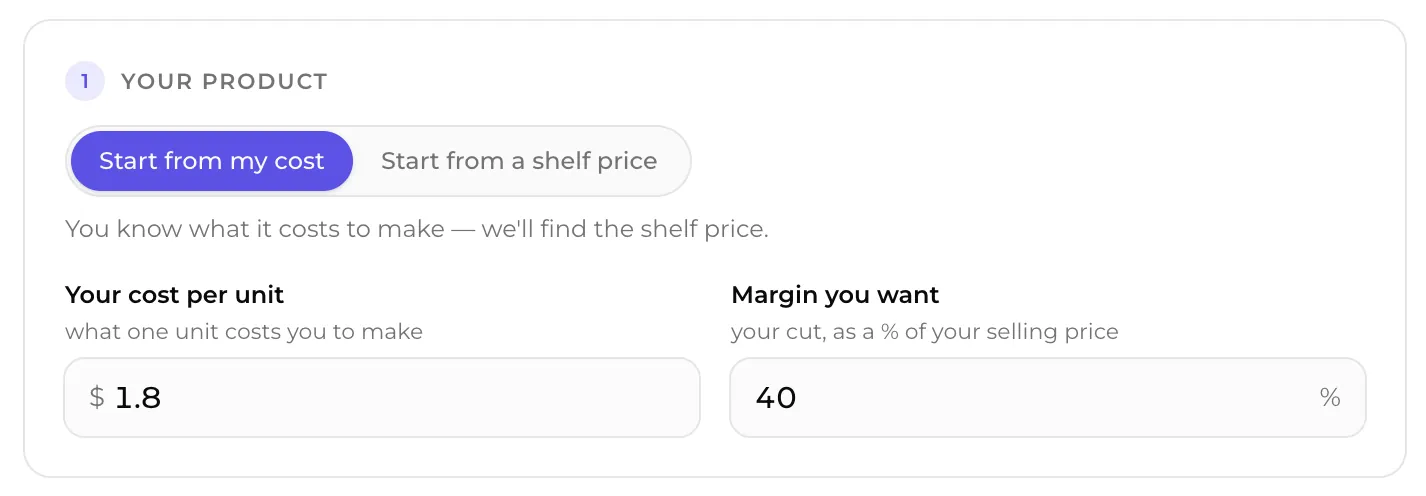
Margin vs markup (and why keystone matters)
Before anything else, get these two straight, because half of all pricing confusion is people quoting one when they mean the other:
- Margin is a share of the selling price: (price − cost) ÷ price.
- Markup is a share of your cost: (price − cost) ÷ cost.
Same $2 of profit, two different percentages. A $10 item that cost $8 has a 20% margin ($2 ÷ $10) and a 25% markup ($2 ÷ $8). This is why keystone pricing — the old retail default of doubling your cost — is a 100% markup but only a 50% margin. When a buyer says they need “50 margin,” they mean half the shelf price, which is a full double on cost at that layer. Quote them a 50% markup when they asked for a 50% margin and you’ve just lowballed your own price by a third — in a room where looking like you don’t know the math is its own kind of death.
What retail margin does each channel actually take?
There is no single “retail margin” — the channel decides it. These are the commonly-cited ranges, and they line up with what brands report across a community dataset of 219 US retail chains (figures brands report paying, not confirmed by the retailers themselves):
| Channel | Retailer margin | Distributor markup |
|---|---|---|
| Conventional grocery | 25–35% | 10–20% |
| Natural / specialty | 35–50% | 10–15% |
| Mass (Walmart, Target) | 25–32% | direct / varies |
| Club (Costco, etc.) | 10–15% | direct |
| C-store / drug | 40–50% | 20–30% |
The pattern to remember: conventional grocery runs the thinnest retailer margins but the biggest volume; natural, specialty and drug run fat margins on lower volume. In that 219-chain dataset, conventional chains cluster around 25–30% and natural around 35–40%, with the median retailer margin landing near 28% — and two names, KeHE and UNFI, are the primary distributor for nearly half of all the chains.
And a warning for anyone eyeing DTC or Amazon as the “keep more of the margin” escape hatch: they have their own tolls. Amazon’s combined take — referral fee, FBA fulfillment, storage, and the ad spend you now have to run to be seen — commonly lands around 30–50% of the selling price. Every channel wants its cut; they just dress differently.
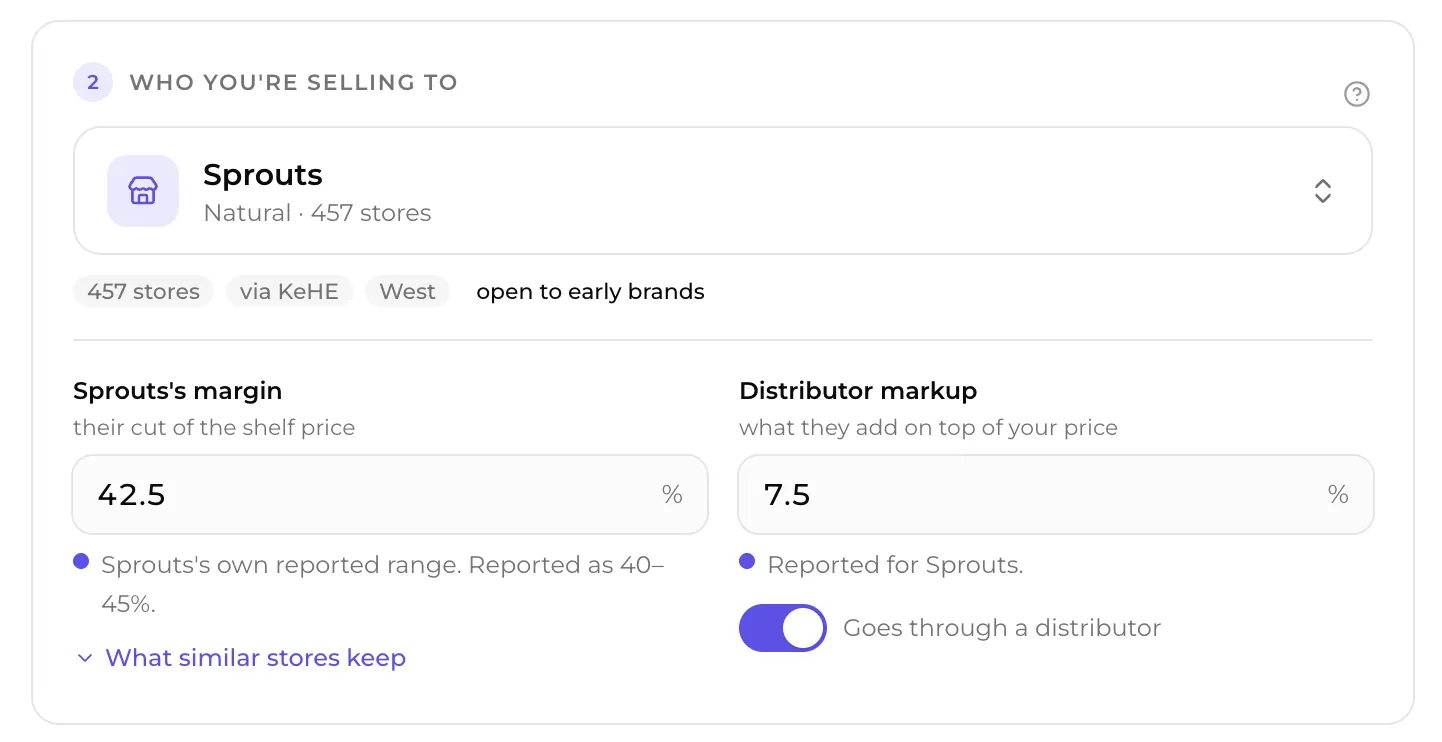
The distributor’s cut (KeHE, UNFI & the middle layer)
If you sell through a distributor — and in natural/specialty grocery, KeHE and UNFI are close to unavoidable — they take a markup on your wholesale price on the way to the retailer. The commonly-cited range is ~15–25%, pushing toward the top on low-volume independent drops where the delivery economics are worse.
“30% is high — that’s a 15–20% job.”
And here’s the trap founders fall into: assuming that selling direct makes that layer free. It doesn’t. Warehousing, freight, delivery and broker fees don’t disappear when you skip the distributor — they just move onto your own P&L and wait for you there. The honest way to model it is to keep that middle markup in either way: it’s a distributor’s cut, or it’s your own cost to get product to the store. Never zero it out.
Slotting fees, disambiguated (the number everyone quotes differently)
Slotting is what a retailer charges to give your product a spot on the shelf — rent for real estate you’ll never own, payable to a landlord who can still evict you at the next reset. It blows up more first-year plans than any other line, and half the reason is that nobody agrees on the number — because they’re quoting different structures. Here they are, separated:
- Per SKU, per store — ~$50–$300 at most chains; ~$250–$1,000+ per item at big national banners. This is the one that compounds.
- Chain-wide authorization (per SKU, per chain) — ~$5,000–$50,000+ for one SKU across the whole chain, charged once, not per store.
- Free fill — free product instead of cash to stock the initial shelf. It’s slotting in kind, and it still comes out of your margin.
- Lump sum — a flat fee per SKU that doesn’t scale with store count.
That distinction is where founders get hurt. “$200 slotting” sounds trivial until you learn it’s per SKU, per store— across 300 stores and 3 SKUs that’s $180,000, which is a very different conversation than the $200 you had in your head. The four most expensive words in CPG really are “per SKU, per store.” In the same 219-chain dataset you’ll see the full spread — from “free fill” to “$100 per SKU per store” to a “$5,000 lump per SKU” — so always confirm which structure a quote is before you sign. (For a deeper read, In Practise has a good breakdown of slotting economics.)
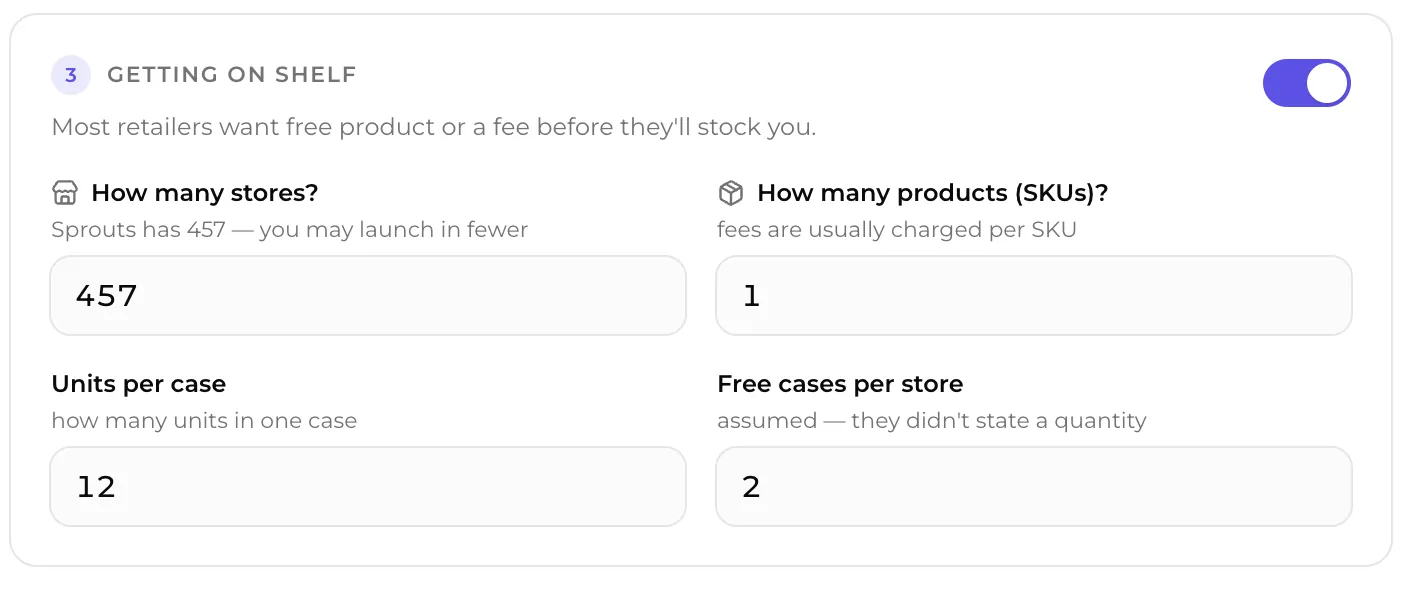
The calculator’s true-margin mode multiplies slotting across your store count and SKUs, so you see the real first-year number before you commit — not after.
Trade spend: TPR, billback & scan (the margin you forget to budget)
Once you’re on the shelf, a second set of costs shows up — the promotions that keep you there. Collectively it’s trade spend, and it’s commonly modeled at ~15–20% of sales (and creeps higher for launch-heavy brands). The three you’ll hear most:
- TPR (temporary price reduction) — a short-term shelf-price cut you fund.
- Billback — the retailer bills you after the fact for an agreed discount or fee.
- Scan promo — you pay the retailer per unit scanned at the register during a promo window.
All three are money off your margin. Budget them in, not around — a plan that ignores trade spend is just optimism with a spreadsheet, and it’s off by 15–20% of revenue from the day you sign.
So what’s your real margin? (contribution margin)
This is the number that actually decides whether your brand survives, and it’s almost never the one on the pitch deck. ~50% gross margin is the widely-cited CPG target — keystone math — but it’s the start of the story, not the end. A 50% gross margin feels fantastic right up until the channel introduces itself. After the distributor’s markup, the retailer’s margin, slotting and trade spend, your contribution margin — what you actually keep per unit — often lands around 10–20% of the shelf price.
“50% gross margin is not enough.”
A useful gut-check, by stage: mature brands aim to hold a contribution margin around 40–50% of net revenue, scaling brands run 30–40%, and much below 25% is where the model quietly stops working no matter how good the product is. That’s not doom — it’s the reality plenty of healthy brands run in. The point is to know it going in, so you set your wholesale price and pick your channels around the number you keep, not the number on the invoice.
How to price a product for retail (work backwards)
Here’s the move that separates founders who make money from founders who get a nasty surprise at reorder time: price backwards from the shelf, not forwards from cost. The shelf price is set by the market — what a shopper will pay next to the competition — so start there and peel the layers off:
- Start with a realistic shelf price. Say $6.99 for your natural-channel product.
- Subtract the retailer’s margin (40%): $6.99 × 0.60 = $4.19, the distributor’s selling price.
- Subtract the distributor’s markup (15%): $4.19 ÷ 1.15 = $3.64, your wholesale price.
- Compare to your COGS. At $2.00 cost you keep $1.64 — a healthy ~45% wholesale margin — but knock off ~18% trade spend and amortized slotting and you’re nearer $1 a unit, ~14% of the shelf price.
If the math doesn’t work in a channel, that’s not a failure — it’s the channel telling you the truth early. Better to hear it from a spreadsheet than to find out at your first PO, when the lesson arrives with a purchase order stapled to it.
The calculator’s reverse mode does exactly this: enter a realistic shelf price and it works back to your wholesale, then tells you whether the channel is affordable at your cost.
Glossary: the terms buyers will use on you
Short definitions of everything above, in the language a buyer will actually use in the room. Each links back to the section that explains it properly.
- Margin
- Profit as a share of the selling price: (price − cost) ÷ price. A $10 item that cost $8 carries a 20% margin. When a buyer asks for “50 margin” they mean half the shelf price.
- Markup
- Profit as a share of your cost: (price − cost) ÷ cost. The same $10 item that cost $8 is a 25% markup. Quoting a markup when a buyer asked for a margin under-prices you by about a third.
- Keystone pricing
- The old retail default of doubling cost to set price. That is a 100% markup but only a 50% margin — the single most common source of pricing confusion in CPG.
- Slotting fee
- What a retailer charges to give your product shelf space. Quoted inconsistently because it comes in different structures: per SKU per store (~$50–$300 at most chains, ~$250–$1,000+ at big national banners), or chain-wide authorization (~$5,000–$50,000+ for one SKU across a whole chain, charged once).
- Free fill
- Free product given instead of cash to stock the initial shelf. It is slotting in kind — it still comes out of your margin, it just doesn't appear as a fee.
- Trade spend
- The promotional cost of staying on shelf once you're on it, commonly modelled at ~15–20% of sales. Budget it in, not around: a plan that ignores it is off by 15–20% of revenue from the day you sign.
- TPR (temporary price reduction)
- A short-term cut to the shelf price that you fund, used to drive trial or velocity during a promo window.
- Billback
- A retailer bills you after the fact for an agreed discount or fee, rather than deducting it at the time of purchase.
- Scan promo
- You pay the retailer per unit scanned at the register during a promotion window — so the cost scales with how well the promo works.
- Contribution margin
- What you actually keep per unit after the distributor's markup, the retailer's margin, slotting and trade spend. Often lands around 10–20% of shelf price, even on a ~50% gross margin.
- Landed cost
- Your all-in cost per unit delivered — product, packaging, freight and duties — before any channel takes a cut. Shelf price typically works out around 3× landed cost once the distributor and retailer are paid.
The bottom line
Retail pricing isn’t hard math — it’s layered math, and the mistake is pricing one layer at a time. Build the whole waterfall: your margin, the distributor’s cut, the retailer’s margin, slotting, trade spend. Then look at what’s actually left — your contribution margin — and price so that number survives. Do that, and you walk into a buyer meeting knowing your floor cold, instead of finding it out the hard way at reorder.
And once the price pencils out, the next job is getting in front of the buyers who’ll say yes. That’s where finding the right retail buyers and pitching them comes in — and it’s the grind Agentworks Scout was built to take off your plate. You can see how Scout runs the outreach in detail.
Agentworks builds AI agents for CPG brands. Its first product, Agentworks Scout, finds the independent retailers that fit a brand, reaches the real decision-maker, and runs the outreach autonomously — so founders spend their time closing, not prospecting. We built the retail margin calculator because pricing for retail is where a lot of good brands quietly lose money.
Published July 29, 2026 · Last updated July 29, 2026