
On this page
The short version: a line sheet is the one-page order form a retail buyer buys from — every product with its SKU, wholesale price, MSRP, case pack, MOQ and terms, one clean row each. It’s not your pitch (that’s a sell sheet) and it’s not a glossy catalog — it’s the doc a buyer scans to decide what to order and how. Get the fields right, lay it out so it reads in one glance, and price it so your margins survive the shelf.
You can have the best product in the category, but if a buyer says “send me your line sheet” and you fire back a Google Doc with three prices and no case packs, you’ve just told them you’re not ready to be on a shelf. The line sheet is a small document that carries a lot of signal — get it clean and you look like you’ve done this before.
What a line sheet actually is
A line sheet — founders also call it a wholesale sheet — is your wholesale catalog boiled down to a scannable order form. It gives a buyer everything they need to place an order and nothing they don’t: what each product is, what it costs them, what it sells for, how it’s packed, the minimum they have to take, and how to order. One product, one row.
It travels. A buyer forwards it to their team, drops it into their buying system, and comes back with a PO. So it has to make sense without you in the room — no “I’ll explain the pricing on a call.”
Line sheet vs sell sheet vs catalog
These three get used interchangeably and they shouldn’t be — they do different jobs:
- Sell sheet — the pitch. One page, one hero product: the story, the hero shot, why it wins the category. It gets a buyer interested.
- Line sheet — the order form. Your whole range, every SKU with price and terms. It gets you ordered.
- Catalog — the lookbook. Bigger, glossier, more lifestyle imagery — often consumer-facing, not built for fast B2B ordering.
“The difference is the intent: a sell sheet sells, a line sheet organizes.”
Most brands need a sell sheet and a line sheet: you open with the pitch, and when the buyer leans in, the line sheet gives them the path to a PO. (More on the pitch itself in how to pitch retail buyers.)
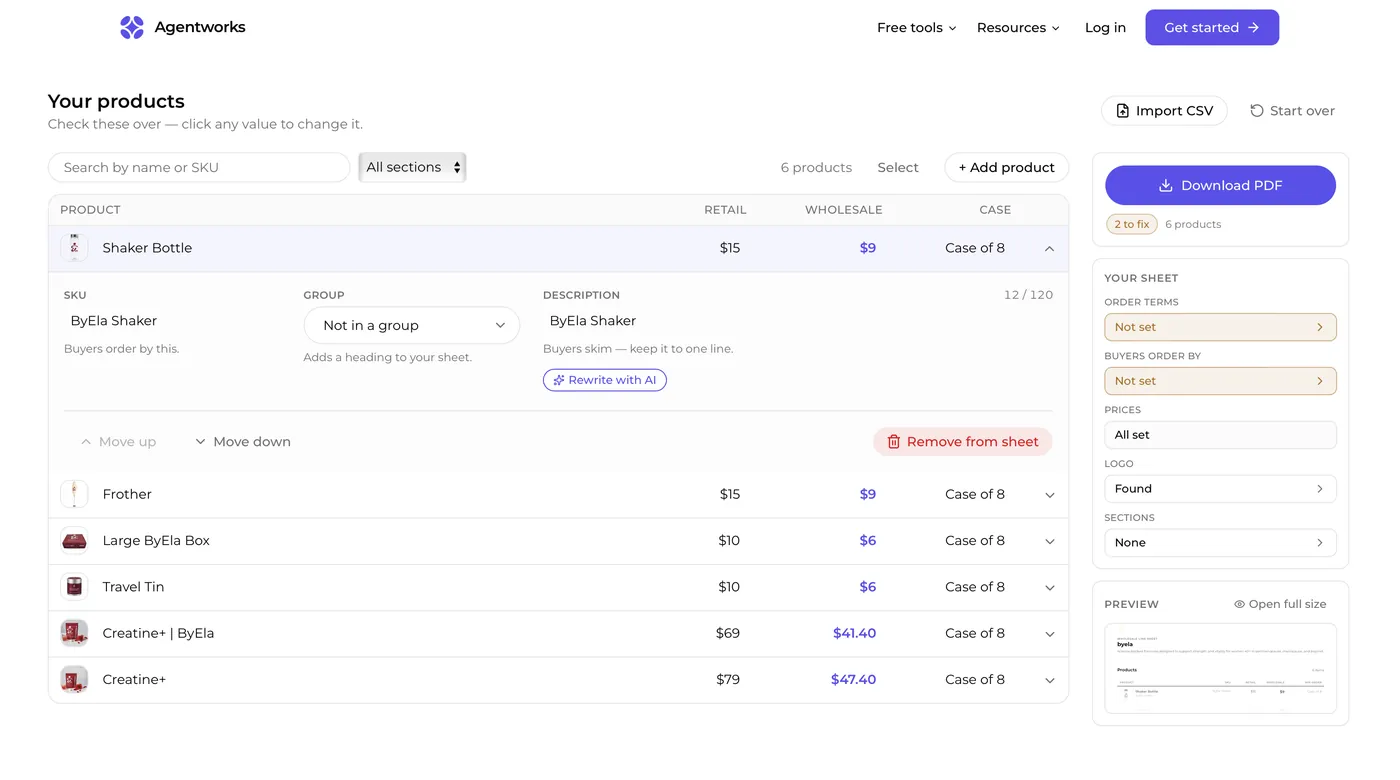
What to include (the CPG checklist)
Most line-sheet guides online are written for fashion — colorways, size runs, fabric content. For a CPG brand the fields are different. Here’s the actual list:
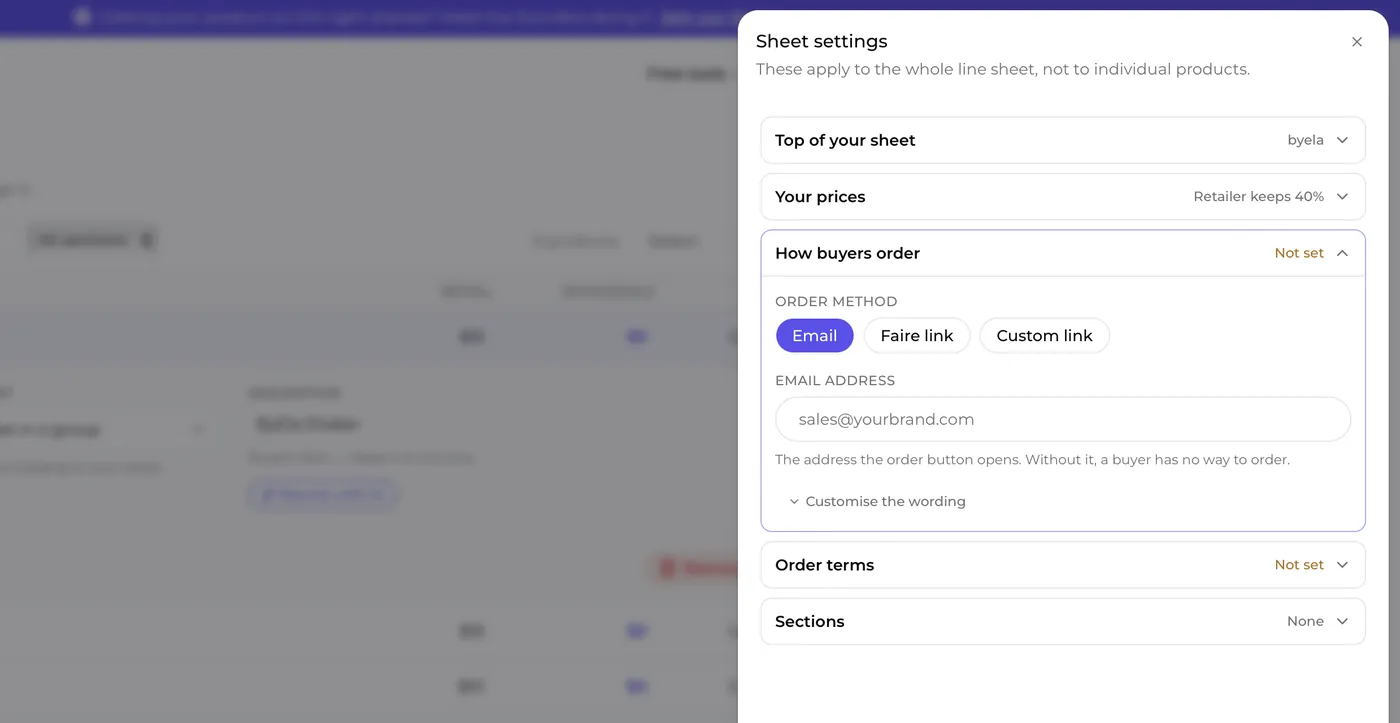
- Header — brand name + logo, a one-line description, and how to order (email, phone, or your ordering portal). Add the season/date so it’s clearly current.
- Product name + SKU/UPC — the exact name and your SKU; include the UPC/GTIN, because chains and distributors need it to set you up.
- Wholesale price + MSRP — what the buyer pays and the suggested retail. Showing MSRP tells them the margin at a glance.
- Case pack + MOQ — units per case and your minimum order. This is the field CPG buyers scan for first, and the one brands most often forget.
- Availability & lead time — in stock vs made-to-order, and how fast you ship.
- Terms — payment (Net 30?), shipping/FOB, and any minimums for free freight.
- A clean product photo — on white, consistent across the sheet.
| Product | SKU / UPC | Wholesale | MSRP | Case pack | MOQ |
|---|---|---|---|---|---|
| Sea-Salt Dark Bar | SB-DK-70 · 8•60000•00000 | $2.40 | $4.49 | 12 | 4 cases |
How to lay it out
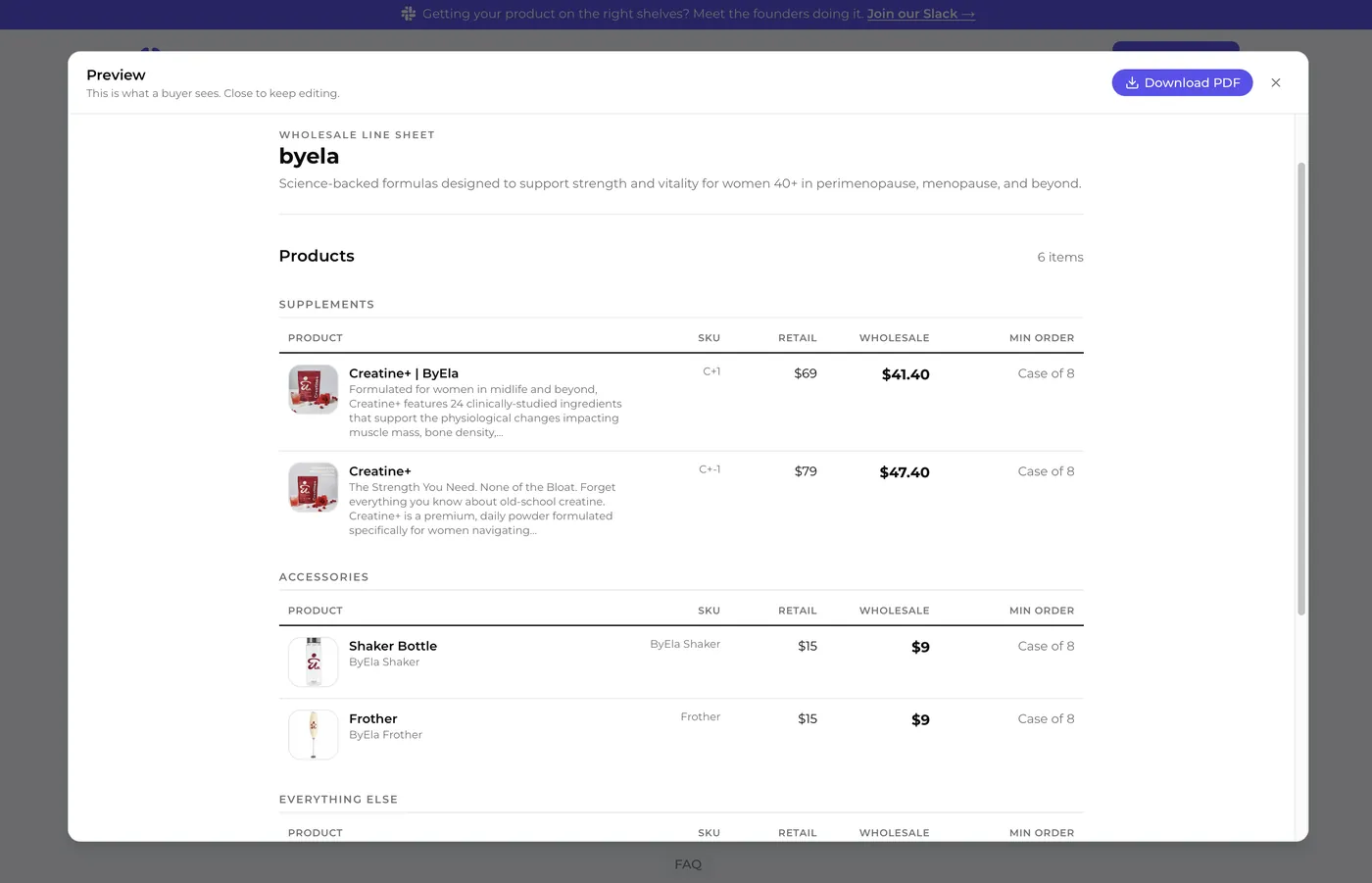
A buyer skims a line sheet in seconds, so layout is the content. The rules are simple:
- One row per SKU, in a consistent grid — never a paragraph.
- Group by category (bars, drinks, minis) so a buyer finds what they came for.
- Prices always visible — never “email for pricing.” That’s a friction that loses orders.
- Export a PDF, not an editable doc — it looks finished and can’t break when they open it.
The goal, as one wholesale resource puts it plainly: the buyer should immediately see what the product is, how much it costs, and where to order it. If they have to hunt, you’ve lost them.
Pricing on your line sheet
The number you put in the wholesale column is a commitment, so get it right before the sheet goes out. Your wholesale price has to leave room for the distributor’s markup and the retailer’s margin and still cover your costs — which is why founders price backwards from the shelf, not forwards from cost.
Showing MSRP next to wholesale does you a favor: it lets the buyer see their margin instantly (a $2.40 wholesale against a $4.49 shelf is a healthy ~47% for them). If you’re not sure your numbers hold up across the whole chain, work them out first — our guide to retail margins, slotting & pricing walks every layer.
Mistakes that get a line sheet ignored
- No case pack or MOQ. The buyer can’t build an order without it, so they don’t.
- “Email for pricing.” Every extra step costs you orders. Put the number on the sheet.
- An editable Word/Google doc. It reads as unfinished and formats break on their screen. Send a PDF.
- A wall of text per product. Buyers scan; they don’t read. One row, key fields, done.
- No UPC. Chains and distributors need it to onboard you — leaving it off stalls the setup.
The fast way: generate it
You can build a line sheet by hand in a spreadsheet or Canva — and if you have five SKUs, that’s fine. But if your wholesale sheet is just an Excel you keep meaning to upgrade, keeping it current as prices and products change is the part that quietly eats an afternoon every season.
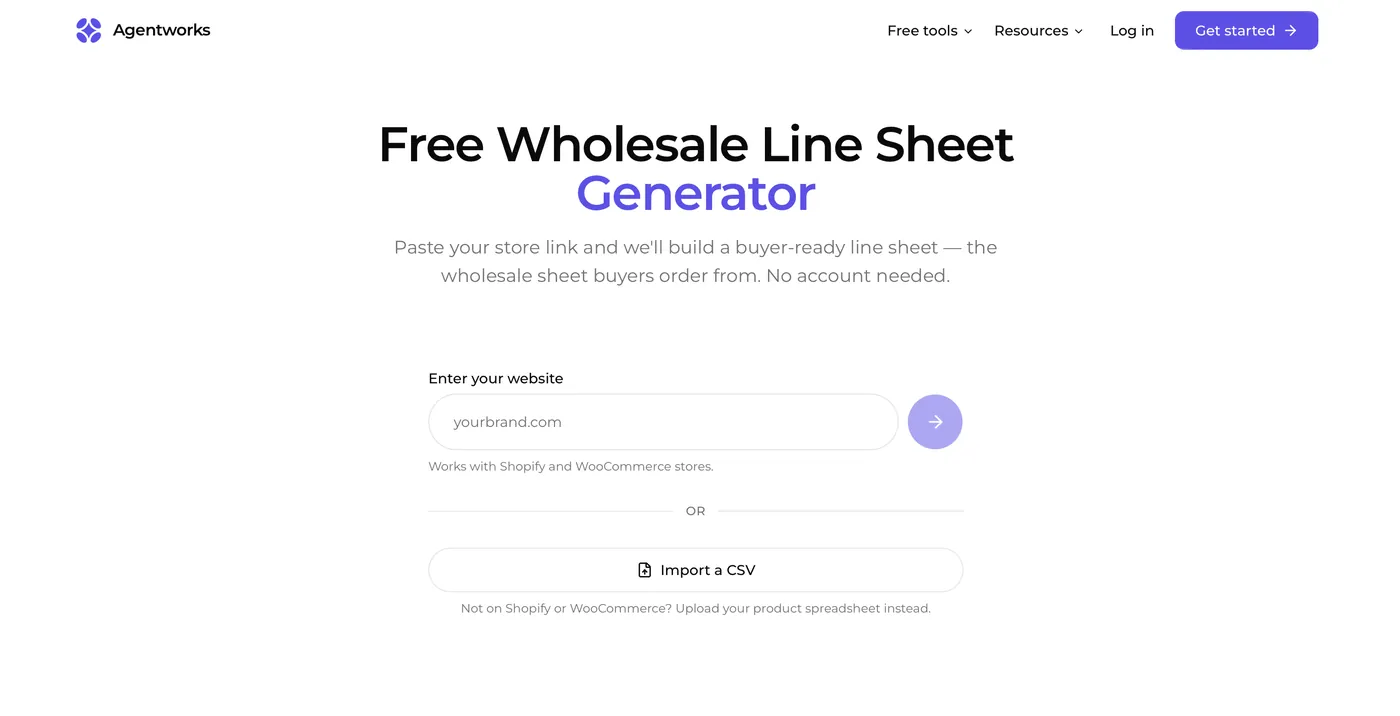
The shortcut: paste your store URL (or upload a CSV) into a generator and let it pull your products, prices and images into a clean, buyer-ready PDF — then tweak anything by hand. It’s free and needs no account.
Skip the spreadsheet. The free wholesale line sheet generator builds a buyer-ready PDF from your store link in minutes.
The bottom line
A line sheet isn’t a design project — it’s an ordering tool. Include the fields a CPG buyer actually needs (SKU/UPC, wholesale + MSRP, case pack, MOQ, terms), lay it out so it reads in one glance, price it so your margins survive, and send a clean PDF. Do that and “send me your line sheet” stops being a stall and starts being the step right before a PO.
Once it’s ready, the job is getting it in front of the right buyer — which is where finding retail buyers and Agentworks Scout come in.
Agentworks builds AI agents for CPG brands. Its first product, Agentworks Scout, finds the independent retailers that fit a brand, reaches the real decision-maker, and runs the outreach autonomously. We also build free tools like the line sheet generator so getting wholesale-ready is one less thing to sweat.
Published July 30, 2026 · Last updated July 30, 2026