
On this page
The short version: pitching a retail buyer is really three jobs — the cold outreach that earns a meeting, the pitch itself, and the follow-up. Almost every guide online teaches the middle one (build a ten-slide deck!) and skips the two that actually decide it. This one doesn’t. And step zero, before you write a word: figure out who you’re pitching, because a corner-store owner and a Kroger category manager are not the same animal.
You already found the buyers — if you haven’t, start with how to find and reach retail buyers first, then come back. This is the next part: turning a name and an email address into a buyer who writes back. It’s the part that quietly eats your week when you’re a team of one wearing all the hats — founder, forklift operator, and, apparently, unpaid cold-email SDR.
First: who are you actually pitching?
Before the subject line, before the samples, answer one question, because it changes everything downstream:
- Small / independent retailers. The person reading your email is the owner, standing behind the counter. They are the decision-maker. It’s personal, it’s fast, and it’s emotional as much as commercial — they buy brands they like from people they like.
- Medium / large chains. There’s a corporate office, and usually a category buyer or a product team who owns those decisions on a review calendar. It’s slower, more numbers-driven, and “do you fit the category and the margin math” beats “do they like you.”
Same product, two completely different pitches. Aim a warm, personal, owner-to-owner note at a Costco buyer and it reads as naïve; aim a spreadsheet of category velocity at a neighbourhood juice bar and you’ve lost them at “planogram.” If you’re early, most of your wins are on the independent side, so that’s where most of this guide points — but we’ll flag the chain differences as we go.
Who actually fits your brand?
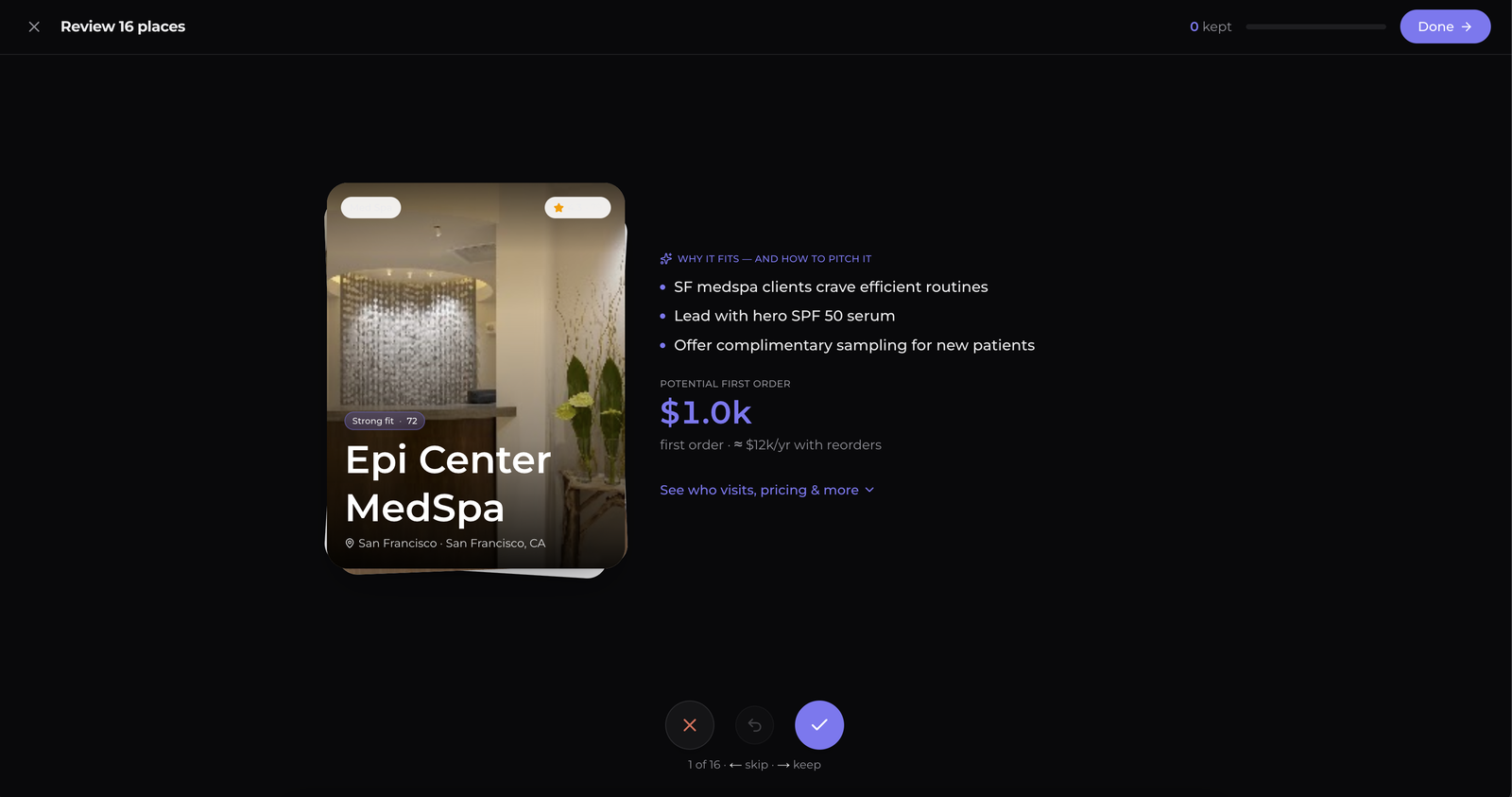
Here’s the part founders skip in their hurry to pitch: not every store is your store. Not every gym, café, or indie grocer fits. There are thousands of them in and around your area, and blasting all of them is how you burn your domain and your afternoons for a 1% reply rate.
The move is to pitch only the places where your actual customer already shops — where your product genuinely belongs on the shelf. That’s exactly what Agentworks Scout does: it “scouts” the independent stores, gyms, cafés, and spas around you, scores each on real signals (what they stock, their crowd, their reviews), and matches the ones that fit your brand. You just skim the shortlist and pick.
Timing beats a clever subject line
You can write the best pitch in the world and it will do absolutely nothing if the buyer never sees it. For an owner-run store, your email is competing with invoices, supplier chaos, and a lunchtime rush — land at 8am and you’re buried by 8:15.
So timing matters more than cleverness. What we’ve seen work for brands: send around lunch, or in the quiet lull right before evening close, when an owner is finally near their phone and not elbow-deep in the register. Scout sends at those higher-open windows automatically, then spaces follow-ups out generously — because no retailer has ever been annoyed by a polite note two weeks apart. They were just busy.
What your pitch email must say
Whoever you’re emailing, the anatomy is the same. Short, human, and built to be skimmed in ten seconds:
- Introduce yourself, fast. One line: who you are and what you make.
- What it is + who already buys it. Social proof does the heavy lifting. And if a store like theirs — or better yet, their direct competitor down the street — already carries you, say so. Nothing moves a buyer like the fear of the shop across the road having something they don’t.
- A sales stat or two. Give them a number that helps them say yes: your velocity, a sell-out, revenue per door.
- The price math — their way. Lead with the suggested retail price and their margin, never your cost. “$8.99 retail, ~53% margin for you” lands; “my cost is $2.40” makes them do arithmetic you should’ve done.
- One clear call to action. Ask for exactly one thing: “Can I drop off samples Thursday?” or “Open to exploring a placement?” And a great bonus ask if you’re not sure they’re the right person: “If someone else handles buying, could you point me their way?”
One more lever for the little guys: an offer. Small stores are moved by anything that helps them earn more — an intro margin, free fill on the first case, a spiff. If you can put a “here’s how you make money on day one” in front of an owner, you’ve started a conversation.
Subject: Kettle & Co granola for The Corner Market — sold out in 3 hrs nearby
Hi Maria,
I’m Sam, founder of Kettle & Co — small-batch granola made 20 minutes from your shop.
I noticed you already carry Wildgrain, so your crowd is exactly ours: the oat-milk-and-Saturday-hike people. Last month we did one demo at Ridgeline Market and sold out their shelf in three hours; we’re now in 14 doors doing roughly $2–3k a month each.
Wholesale is $4.20/unit at an $8.99 suggested retail — about a 53% margin for you. Could I drop off samples Thursday or Friday? (And if someone else handles grocery buying, point me their way and I’ll get out of your hair.)
Catalogue and line sheet attached.
Thanks,
Sam — Kettle & Co
- Subject names their store and a proof point — not “Partnership Opportunity.”
- Real name, local hook, and a brand they already stock (same customer).
- One hard proof stat, then SRP + their margin — never the founder’s cost.
- Exactly one CTA, plus the “who else should I talk to?” escape hatch.
- Line sheet attached, so there’s nothing to chase.
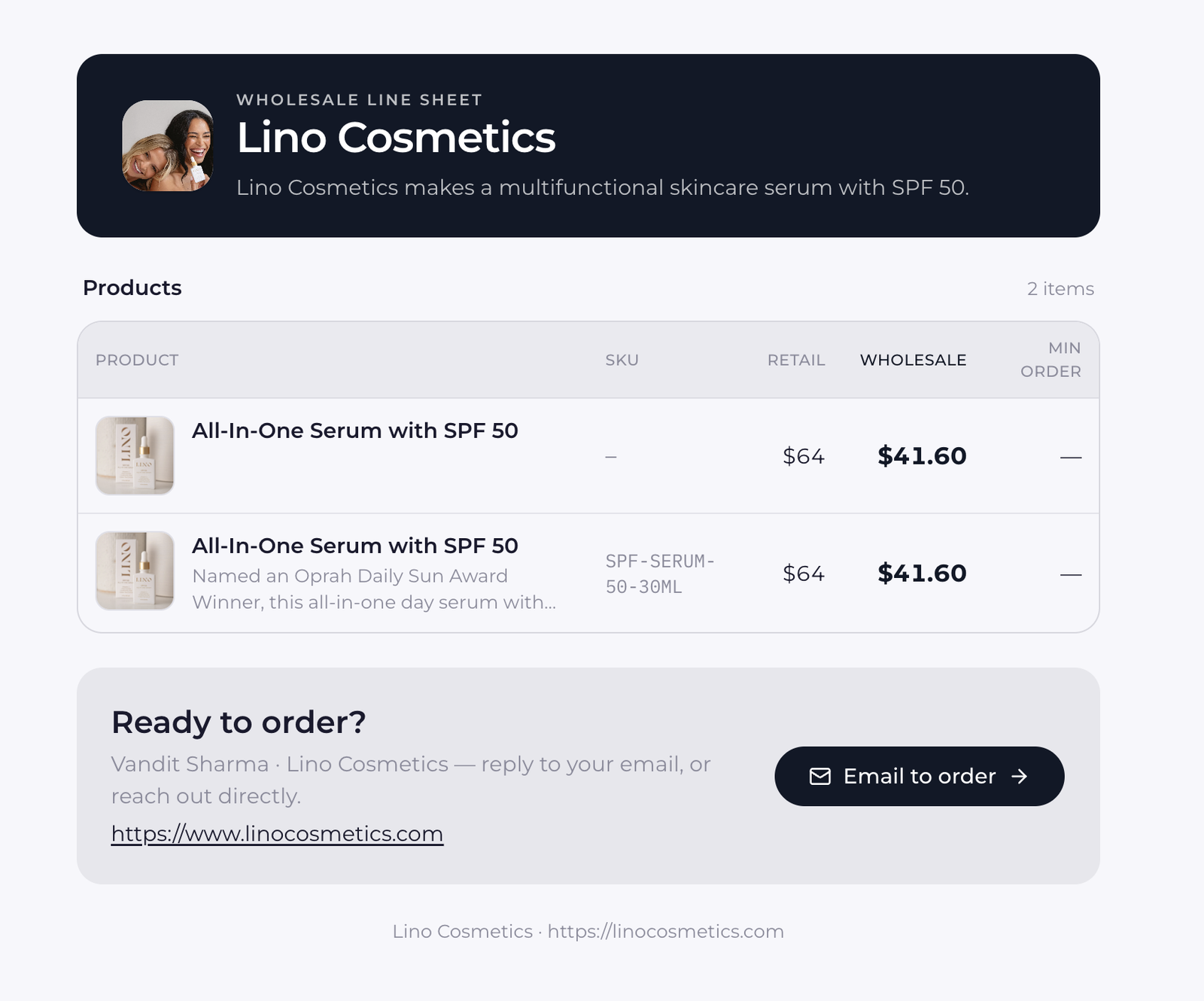
Your catalogue and line sheet (non-negotiable)
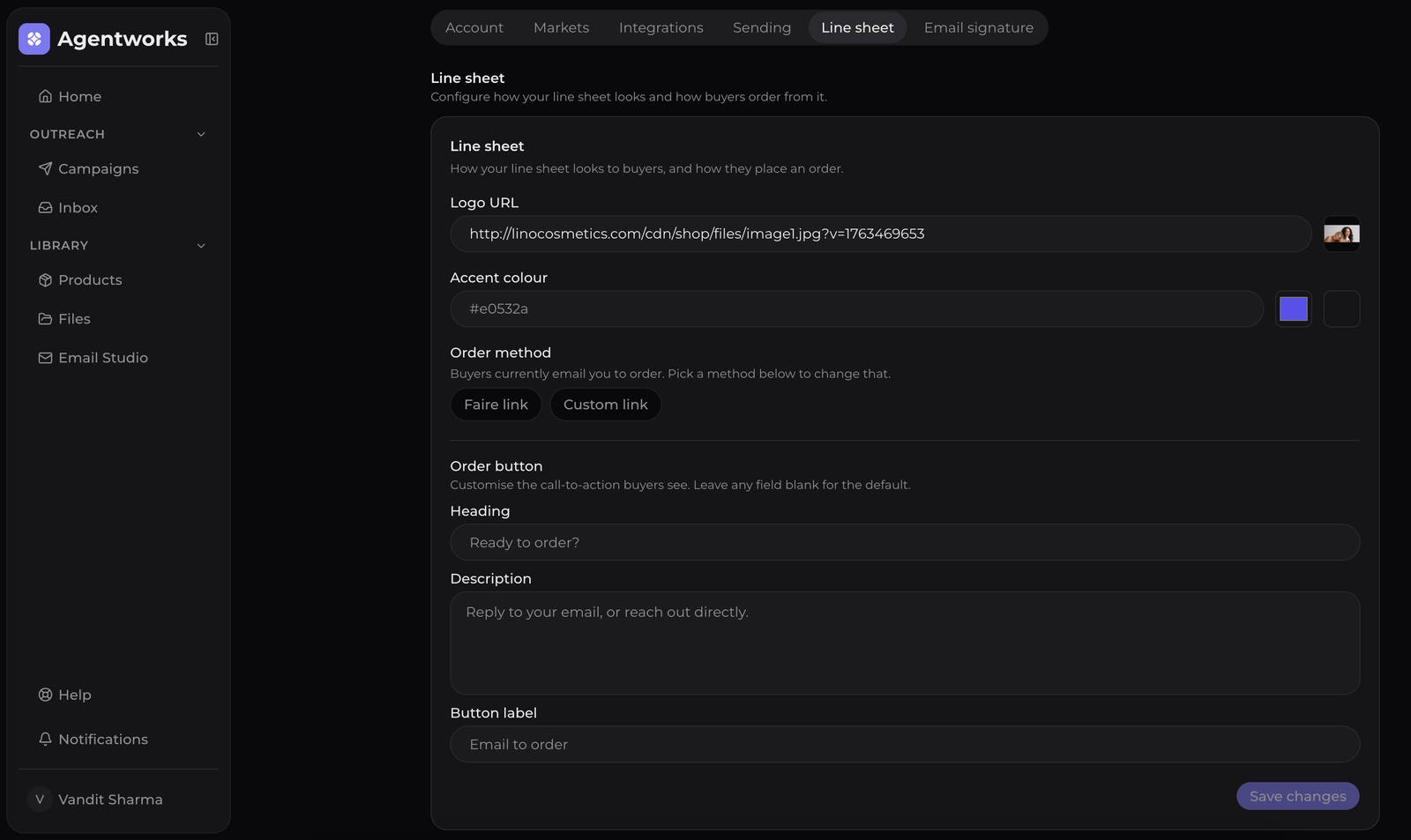
A buyer cannot say yes to a vibe. They need wholesale pricing, case packs, MOQs, and terms in front of them — that’s the line sheet, and pitching without one is like showing up to a job interview and promising to email your résumé later. If you don’t have one yet, that’s a real blocker… unless your tool makes it for you. Scout generates your catalogue and line sheet, and lets you customise it, so every pitch goes out complete.
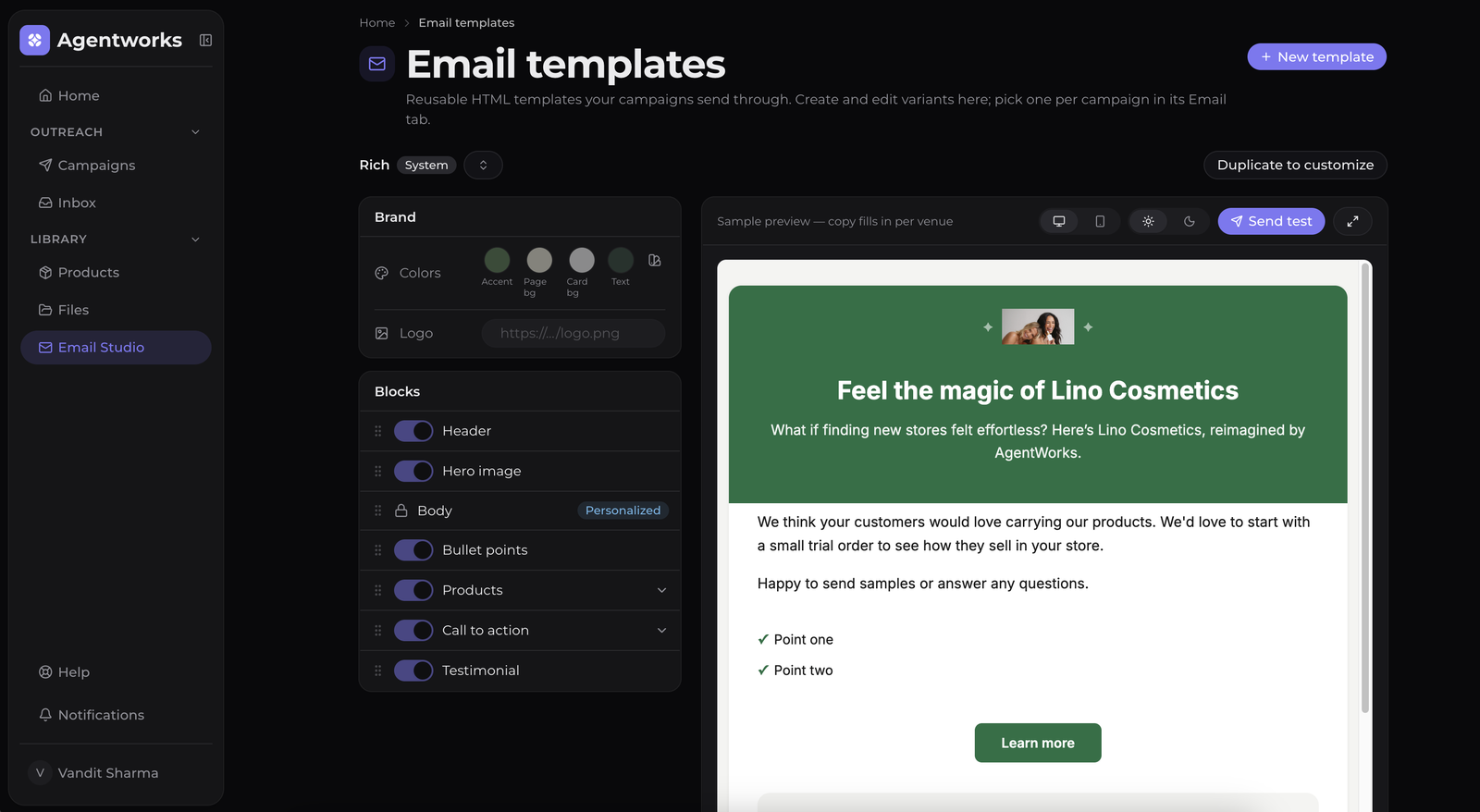
Send it as a branded email, not a wall of text
Here’s something brands consistently see: a well-designed HTML email — your logo, your colours, the product shown right there in the body — pulls more replies than a grey wall of plain text. The buyer gets a feel for the brand before they’ve opened a single attachment, and seeing the product in-email does more than “PFA catalogue.” (You still attach the catalogue and line sheet — the design gets them looking; the attachments let them buy.)
The pitch itself: the numbers that get a yes
If the email earns you a real conversation or a meeting, the pitch has to hold up. Buyers — especially at chains — are people with internal targets; your job is to make their number look good. Keep it to what matters:
- SRP and their margin, front and centre. Still never your cost.
- Proof it moves: velocity, sell-through, repeat rate — whatever shows the product doesn’t just sit there being pretty.
- Terms: case pack, MOQ, lead time, and any intro deal — the boring stuff that decides real orders.
“A lot of it is the follow-up more than the presentation.”
The follow-up: where deals are actually won
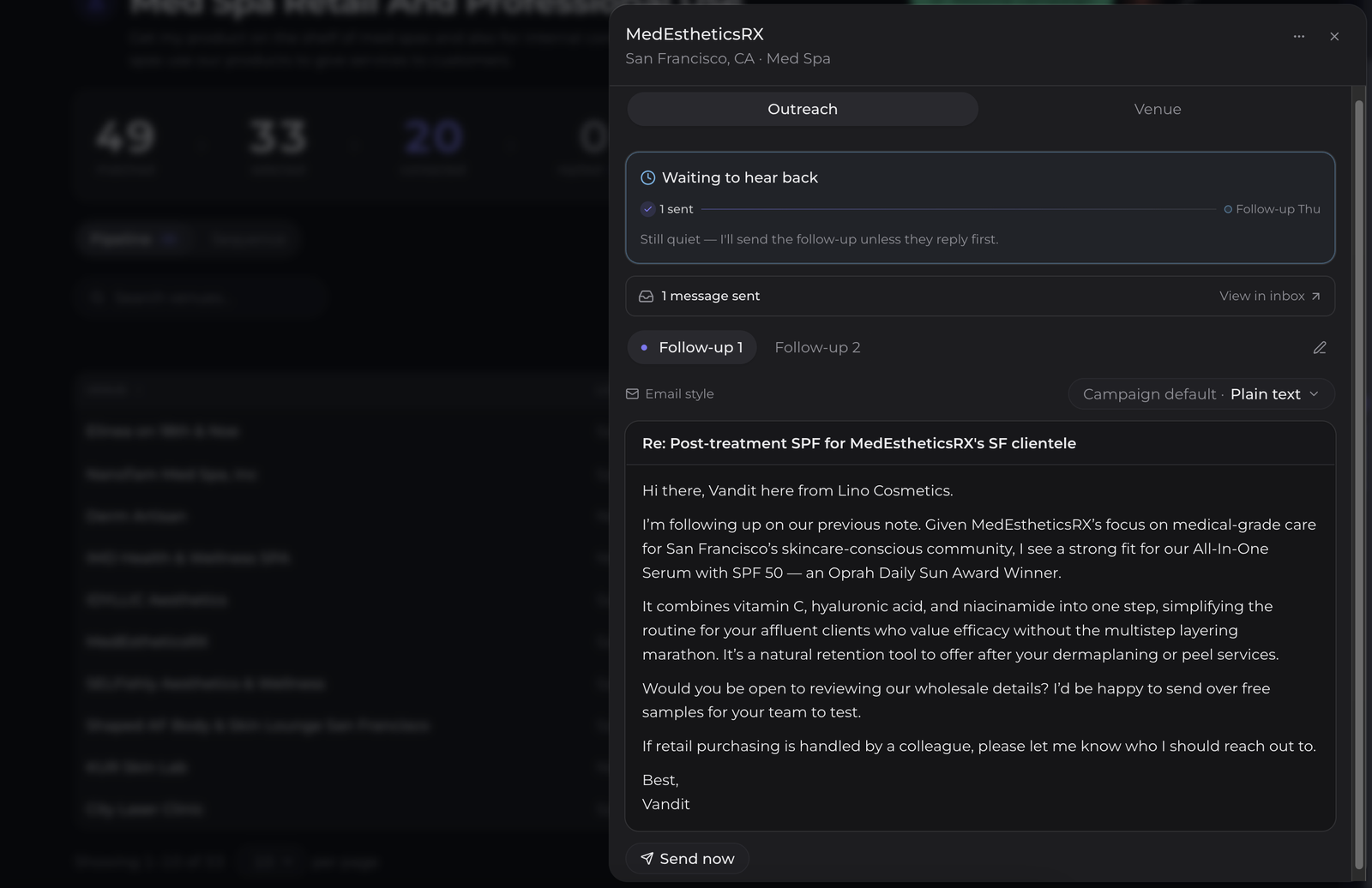
Most founders send one email, hear nothing, and quietly decide the buyer hated them. The buyer didn’t hate them. The buyer didn’t see them, or saw them on a bad day. The reply is almost always sitting on the other side of a follow-up nobody sent.
Two rules. First, be persistent but spaced out — a gentle nudge every week or two, indefinitely, beats three emails in three days and then silence. Second, follow the behaviour: if you can see a buyer opened your email, that’s your cue — follow up a day or two later, while you’re fresh in their mind. Scout tracks opens and runs exactly this cadence for you, so you’re nudging warm leads at the right moment instead of guessing.
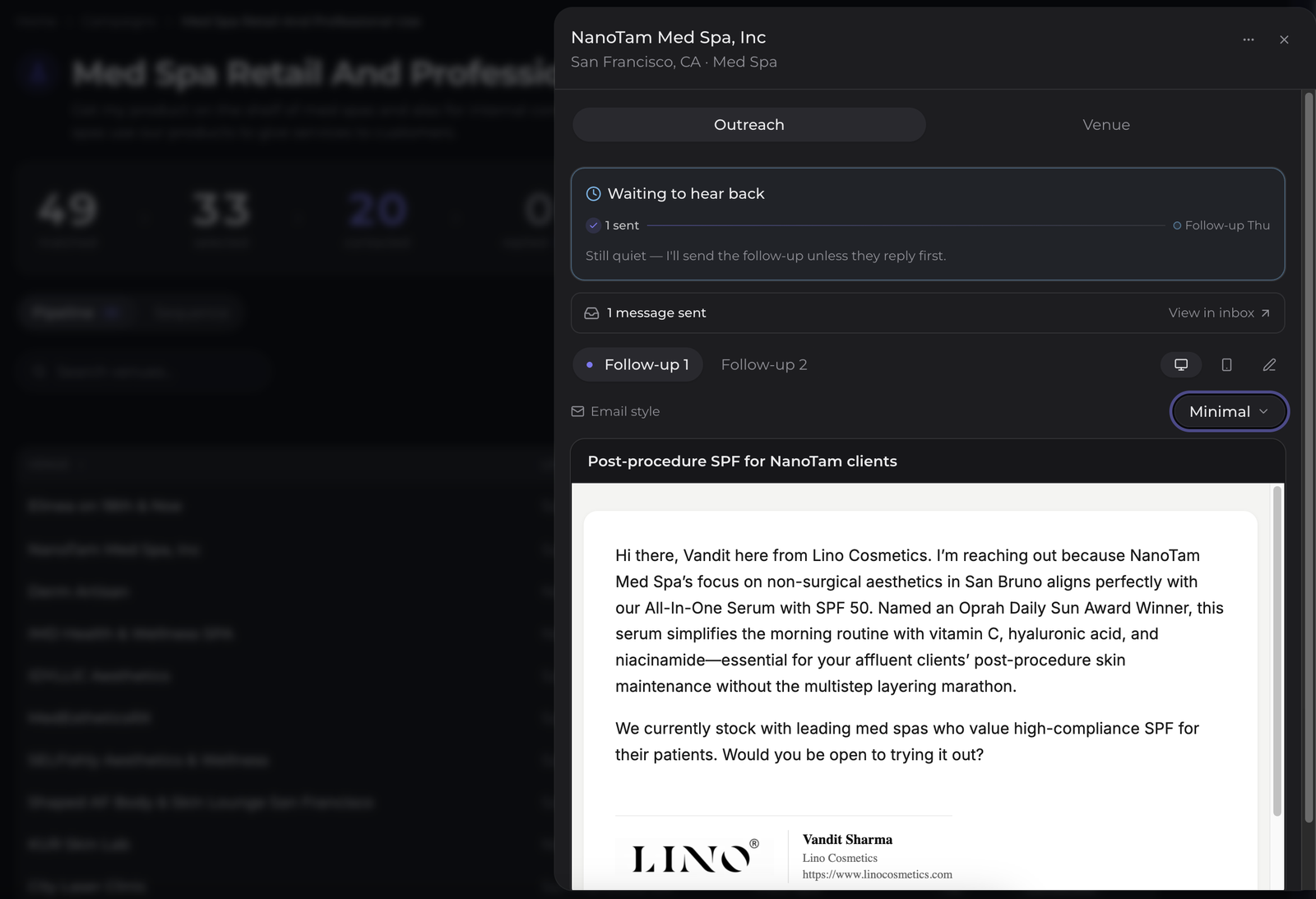
Subject: re: Kettle & Co for The Corner Market
Hi Maria — floating this back up in case it got buried (I know the inbox is a warzone). Still happy to swing by with samples whenever suits — no rush at all, just didn’t want it to slip.
Sam
- Short. References the first email so it’s not a cold restart.
- A little warmth and humour, zero guilt-trip.
- One ask, and an explicit “no rush” that lowers the pressure.
Protect your domain (or none of this matters)
You can do everything above perfectly and still get nowhere if your emails quietly land in spam. Cold outreach done carelessly torches your sender reputation, and your email platform will never tell you it happened. Three basics: authenticate your domain (SPF, DKIM, DMARC), warm a new sending domain up for a couple of weeks before you scale, and send at a human pace — not a thousand identical blasts from a cold domain at 3am.
How much does this quietly matter? One founder discovered that leftover DNS from an email tool he’d cancelled months earlier had wrecked his domain’s deliverability — his pitches had simply stopped landing and he had no idea why.
“I reset it, and the very next email did 17× the revenue to the exact same list.”
Same list. Same product. The only variable was whether the emails arrived.
Doing all of this, at scale, without an SDR
Read back over this guide and notice how many separate jobs it is: match the right stores, find the owner, write a personal pitch, time the send, attach a line sheet you may not have, design the email, track opens, and follow up on cadence — times a few hundred stores. That’s not a task. That’s a full-time sales hire you can’t afford yet.
That’s the whole reason Agentworks Scout exists. It matches the stores that fit your brand, tracks down the real buyer, writes each pitch in your voice as a branded email, sends it at the right time, generates your line sheet, watches for opens, and runs the follow-ups — then books the meeting on your calendar. You show up and close. Your first two buyer meetings are free, and there’s no catalog to upload — just your website and a city.
The bottom line
Buyers don’t reject pitches because the subject line wasn’t clever enough. They reject them because the email didn’t answer the only question they have — will this sell here, to my shoppers? Everything in this guide is a way of answering that faster: pick stores where the answer is already yes, send it to the person who can act on it, lead with the proof rather than your origin story, and follow up like a professional instead of apologising for existing.
None of it is complicated. It’s just relentless — and relentless is the part founders run out of first, usually around store forty. Do it by hand while the volume is small and you can learn what lands; automate it once you know, so the follow-ups keep going out on the weeks when everything else is on fire.
Agentworks builds AI agents for CPG brands. Its first product, Agentworks Scout, finds the independent retailers that fit a brand, writes and sends the pitch, runs the follow-ups, and books the meeting — so founders spend their time closing, not prospecting. See how Agentworks Scout runs the outreach.
Published July 23, 2026 · Last updated July 23, 2026